No Ads on QR Scans: China Food Labels Make That a Rule
If you print a food pack for the mainland, the first page after the scan cannot be an interstitial.
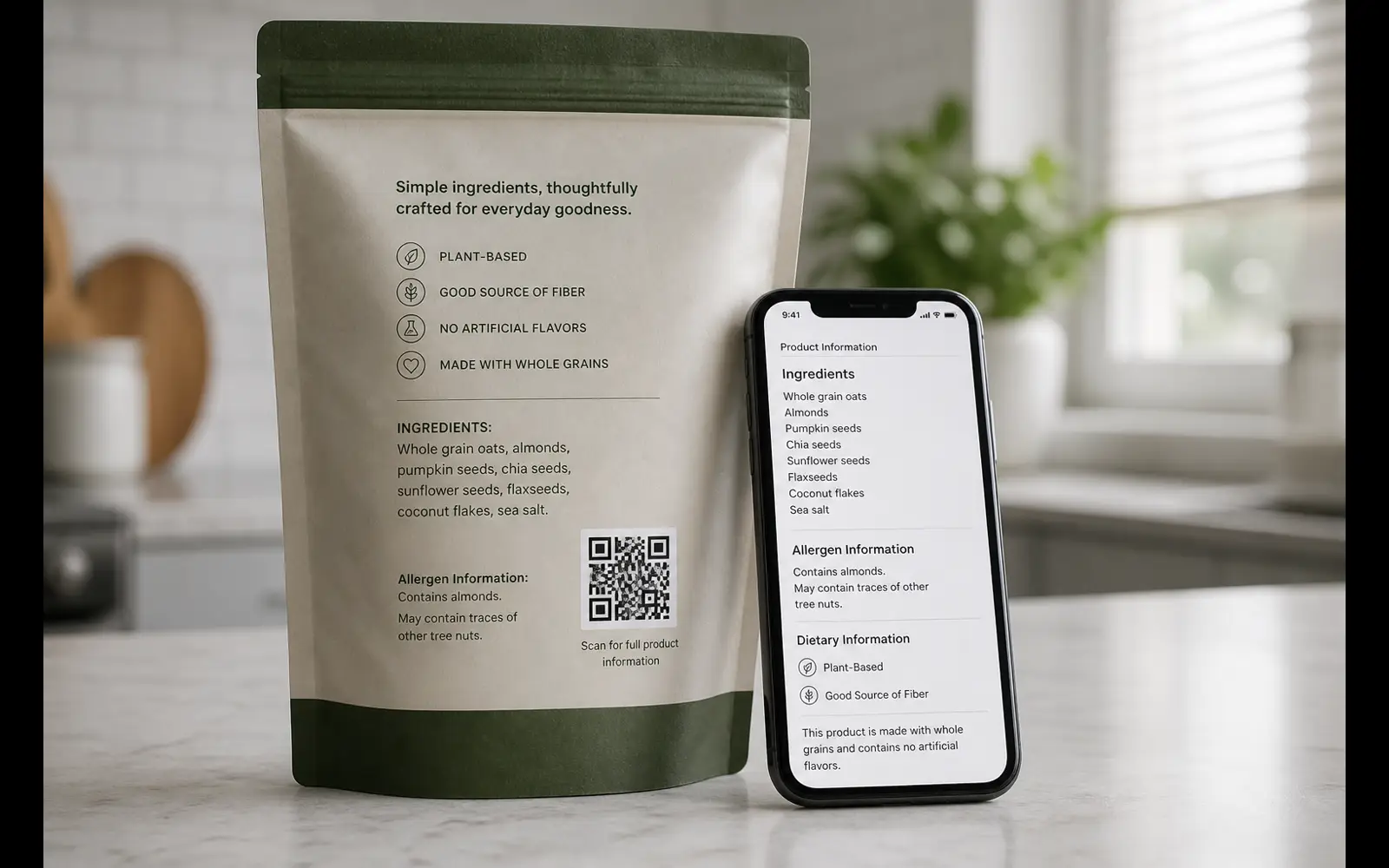
If you print a food pack for the mainland, the first page after the scan cannot be an interstitial.
That is not a brand preference. From 16 March 2027 it sits in the food-label rule. A till code is a different job. This is about the page a phone opens.
The first page is now a label
The 2025 mainland labelling standard for prepackaged food (GB 7718-2025) was issued 16 March 2025 and takes effect 16 March 2027. Digital labels are new in this revision. They are encouraged, not required. A producer may add a digital label on a pack that already complies. If they do, the scan rule is: the label content has to appear on the first page after the code is read, with nothing that gets in the way of reading it.
A 29 July 2025 notice from the National Health Commission and the State Administration for Market Regulation names the clutter. Digital-label content must be clear and easy to read. No overlapping. No stacking. No pop-up windows, no floating windows, no other interference. Advertising and marketing are not digital-label content.
You do not have to put a QR on a mainland food pack. If you do, and you treat that QR as the digital label, the first thing the camera opens cannot be someone else's interstitial.
What a Hong Kong food forum put on the calendar
On 28 August 2026 GS1 Hong Kong ran its Food Safety Forum. Keith Wu, chair of the food and beverage advisory board, told the room that the mainland general labelling standard and the food-labelling supervision measures take effect in March 2027. Digital labelling is in the standard for the first time. Firms are encouraged to show more product information through QR codes.
That is a date, not a product to buy from GS1. We do not run a GS1 resolver. We are not a Digital Link vendor. We are not a China compliance shop. The mainland rule is about the first page a phone opens.
What the print actually needs
A vendor that injects an ad before your page is not a free QR. It is a first page you do not control. For a mainland food pack using a digital label, that first page is the problem.
What we ship is simpler than a compliance platform. We do not put an ad on the scan path. That is true on Free. It is true on paid plans. It is not a Pro upsell.
The rest of the printed object is the same story we already tell.
- The code does not expire.
- Scans are unlimited on every plan, including Free.
- If you stop paying you drop to Free. You are not cut off. Last year’s sleeves keep resolving.
- The destination is editable. That is a dynamic code. Print once. Change the page when the copy, the recall, or the campaign changes.
- If the pack has to look like you, put the short link on a hostname you own. Custom domains are Pro. See QR codes on your own domain and what happens if you cancel.
Plans, August 2026: Free $0, Lite $8/mo, Pro $20/mo, Business $49/mo. API, MCP, and custom domains are Pro. Bulk is Business.
None of that makes the destination a legal digital label. The page itself — ingredients, dates, the words next to the code, whether ads sit on your site — is your job, or your counsel’s. We do not certify packs. We do not mint a GS1 URI. We do not sit between the phone and an interstitial of our own.
Do not print a first page you cannot defend
If the run is for the mainland and the QR is the digital label, the first open has to be the label. Not a skippable ad. Not a floating chip. Not a “continue to the product” gate.
Pick a resolver that will not put one there. Keep the destination editable so the label copy can move without another plate. Then leave the legal page to people who write labels.